|
Dick's Bluegrass
Odyssey Volume 5 |
|
| Related Links | |
| Chapters 1 - 4 Chapters 5 - 8 Chapters 9 - 12 Chapters 13 - 16 | |
|
The first five chapters of this series originally appeared in the Fresno Folklore Society Flyer. It was decided to discontinue publishing them and make them available only on line. It should be noted that information about most of these festivals has been included in my travel reports. But those pages were written for a general audience, while this series is aimed specifically at fans of folk music. --Dick Estel, September 2026 |
|
|
My Bluegrass Odyssey Chapter 17 Chapter 18 Chapter 19 Chapter 20 by Dick Estel The Brown Barn Festival came to an end, and I stayed there Sunday night and got started about 9:30 Monday morning, heading north to the Napa Valley, the most famous wine grape region in the state. About five miles past St. Helena, and about the same south of Calistoga, I arrived at Bothe-Napa Valley State Park, located in the hills on the west side of the valley. The campsites were located along a small creek, on the dry eastern slope, which is covered with manzanita, madrone, and oak trees. On the cooler, wetter western slope above the creek there were evergreens, primarily Douglas fir and coast redwoods. There were no giant trees, but lots of tall redwoods, one to three feet in diameter. The next day I took a one-mile trail to the Bale Grist Mill, another nearby state park. The mill was built in 1846, and restored in recent years. A school group was getting a tour when I arrived, so I tagged along and learned much more than I would have by just looking around on my own. They grind several kinds of grain at the mill, including wheat, buckwheat, and corn, and give away the flour (a donation is appreciated). In 1840 there were over 24,000 mills operating in the United States. The Bale's millwright relied heavily on a book first published in 1777, The Young Millwright and Miller's Guide. If you plan to operate a mill, this publication still has much to offer. I continued to “drift,” staying overnight at an RV park in Vacaville, and continuing on to the next bluegrass festival site, Plymouth on CA Highway 49, my 5th time at this festival. I was able to get a spot in the livestock barn, which means electric and water hookups. I visited with my friends and former classmates, Bryce and Alma Green from Cathey's Valley in Mariposa County, who had arrived about 2 p.m. Thursday night they always have a bluegrass-related film presentation, and this year it was a PBS special on the Carter Family, who need no explanation for fans of folk and early country music.. Friday morning’s festivities started with the emerging artist program. This allows four newer and lesser-known groups, usually from California, to compete for the chance to play here for pay next year. Two of the groups were new to me, one was here last year, and one was the Dalton Mountain Gang from the Fresno area, whom I've seen a number of times. In my opinion, they were significantly better then the other three groups, and for a change, the judges agreed with me and declared them the winner. The revelation this year was a group from western North Carolina, Town Mountain, that I had not heard of before. They had played in California before and were impressed by a young Bay Area fiddler, Annie Staninec, who now plays regularly with Kathy Kallick. Since they had no regular fiddle player, they decided to use her for their California appearances, and also had her play on their latest CD. There were two groups from the east that I was aware of but had not seen, and both lived up to expectations. I had read about the Steep Canyon Rangers and bought one of their CDs a few years earlier. Grasstowne had formed about three years previously after the breakup of the very popular and successful Mountain Heart. Lead singer Steve Gulley formed the new group along with one of the world's top dobro players, Phil Ledbetter. The group also included Alan Bibey, a founder of IIIrd Time Out and veteran of a number of other bands, and two other musicians with lengthy resumes. On Saturday I saw three bands whose presence on the schedule had helped convince me to attend this year's Plymouth festival. Two members of the Navy Band, which I had seen a number of times, had left the service, and now had their own bands. First up was Frank Solivan and Dirty Kitchen. He was the fiddle and mandolin player, and did an occasional vocal, but with his own group he was the lead singer, and did a great job. He was still quite young, so I suspect he served a single four year hitch. He's originally from Modesto, and his father, the late Frank Sr., managed the Kids on Bluegrass performances in northern California; Frank Jr. was the "original kid on bluegrass." The Navy Band's lead singer, guitarist, and chief was Wayne Taylor, who served a four year hitch in his youth, then came back as a full-time musician, spending a total of about 25 years. His band was called Appaloosa, and they also did a great job. Closing out the day was Audie Blaylock and Redline. He had been performing for several decades, starting out with the late Jimmy Martin at the age of 19. I had seen him previously, singing with Michael Cleveland and Flamekeeper, and his own band was equally hot. My 2009 bluegrass wandering concluded with the Hobbs Grove Festival, just 20 miles from home. The opening group was newly formed, but has become a Fresno favorite, Uncle Ephus, who proclaim themselves "not just an old-time band." The remaining bands on Friday were all ones I had seen, including two that performed at Plymouth. Actually the full Anderson Family did not appear there, just the kids. As a band, they had significantly improved since I first saw them several years earlier at Plymouth. My favorite was a group I saw at Parkfield in 2008, The Brombies, whose bass player was the late Bill Bryson. Saturday's festivities started off with a San Joaquin Valley band, Groundspeed, which was distinguished by a very hot banjo player. The other groups that morning were Country Grass, a mostly instrumental group headed by Frank Solivan Sr. and Bluegrass Conspiracy from Turlock, which later became Red Dog Ash. The rest of the day brought a mix of bands that were new to me and bands I had seen numerous times. There were two standouts - first Deep Elem, a Santa Cruz band that played some old time material mixed with more typical bluegrass. I had seen all the members of this band in other groups, notably Annie Stanineck. The other group was the Barefoot Nellies, an all-female group, also from the San Francisco area. I had seen them at Plymouth, but had forgotten how good they were. Their guitar player was 16-year old Molly Tuttle, who has become nationally known, and was excellent. This was the first time I had ever attended festivals three weekends in a row, and it was not something I wanted to make a practice of, but I have to say I enjoyed each event, and was glad I decided to do it. I’ve been wanting to say a few words in the category of “where are they now?”, and there’s space to do that here, focusing on the kids. The Cherryholmes family had some national success, getting help along the way from Rhonda Vincent, Jimmy Martin and Ricky Skaggs. Then the kids grew up. Banjo whiz Cia appeared with a group from the east for a while and was married. Guitarist Skip married the daughter of a musician and helped form the successful band Sideline. AJ Lee formed the highly acclaimed Blue Summit that included several top musicians who started out as kids, including Sullivan Tuttle and Scott Gates. They have toured the USA and the world. Marty Varner wrote a very perceptive column in the California Bluegrass Association newsletter for a while, but it was dropped when the publication was revamped (not for the better, in my opinion) during the Covid pandemic. I’m sure he’s still playing somewhere and boldly speaking his mind as he did from very early in his career. The Schwartz Brothers, Max and Nate pursued other musical forms in addition to bluegrass. Max is appearing with Laurie Lewis at several shows in the summer of 2026. Me? I’m going to to take a nap, then move on to 2010. |
|
 |
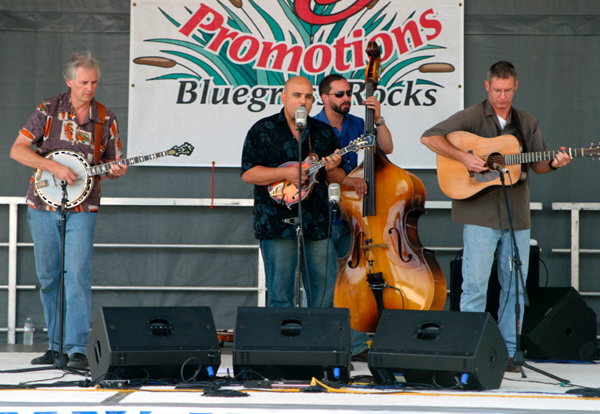 |
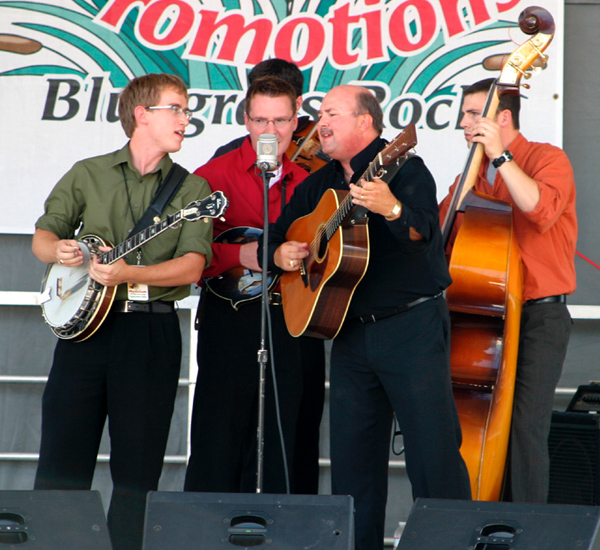
| Audie Blalock | Frank Solivan & Dirty Kitchen |
|
Chapter 18 Chapter 17 Chapter 19 Chapter 20 Like the previous year, 2010 started off with a one-day festival (including optional buffet dinner) in Clovis. The three bands that each did two sets will be familiar to many Fresno folk fans. They were Bluegrass Conspiracy (later Red Dog Ash) from Turlock; Smiley Mountain Band, the pride of North Fork; and Fresno area’s own Dalton Mountain Gang. The workshops included clawhammer banjo by Bill Hunter. I had seen him at a local pizza restaurant with the Music Farmers, years before this Odyssey got underway. The first “real” festival of the year was Bluegrass on the River, which had moved from Parker to Lake Havasu AZ. I made it a two-day trip, with an overnight stop at Mojave National Preserve. Friday, March 5 was a day of good bluegrass, good weather, and gathering with good friends. The groups that day were all ones I'd seen anywhere from once to a half-dozen times. Most familiar to me was the Dalton Mountain Gang, who had been at the last five festivals I had attended. The outstanding group of the day was Michael Cleveland & Flamekeeper, featuring three musicians who won the honor of best of the year on their instrument - Marshall Wilborn, bass; Jessie Baker, mandolin, and Cleveland, fiddle. The appearance of Wayne Taylor and Appaloosa included a special treat - he was joined by his former colleague from the U.S. Navy Band, banjo player Keith Arnason, who was on leave. Wayne had retired a while back and had been touring with his own band since then. The setting is very nice, about 100 feet from the lake, with the water partially visible. The weather was perfect, warm enough to wear a T-shirt all but the last half hour or so. There were some thin clouds, and the possibility of rain Saturday and Sunday, which would be the opposite of perfect. As always happens when my old classmates Bryce and Alma Green and their family are present, I was invited to dinner. We had excellent prime rib, cooked to perfection by Bryce’s brother John Upton and his wife Marie. The perfect weather continued on Saturday, but Sunday it turned horrible. I'll get to that in a minute. On the positive side, Saturday was maybe a bit warmer than Friday, and the music was just as hot. A group that I thought was new to me was Don Rigsby and Midnight Call. After watching them for a while, I realized I had seen them at one of the Plymouth festivals. My favorite group of the day, the main one that drew me to this festival, was Nothin' Fancy, a group from Virginia that puts on a highly entertaining show. They were the last act of the day, and played for 90 minutes, instead of the usual 50. Their rendition of “Pass Me By” must be seen to be appreciated. Suffice it to say that there is a point where the music stops abruptly and the group goes through the audience, shaking hands with everyone. The music then continues as if this had never happened. Luckily all the groups scheduled for Sunday had already appeared at least once, since as far as I know they did not appear on Sunday. It rained a little off and on during the night, then started coming down hard and steady by the time I got up about 8:20. When it was time for the music to start it was still raining, and I accepted the fact that this would be a two-day festival. At most festivals I would have waited it out to see what the afternoon would bring, but I planned to leave by 2:30 anyway. I sat in the motor home reading, waiting for the rain to slack off so I could go down and retrieve my chair. By 11 a.m., it not only had not slacked off, it had become a very ambitious, hard, wet rain. I got my umbrella and walked down to the audience area. There were only a few people around, standing under awnings, many chairs were gone, and the vendors were either gone or packing up to leave. I did the same, stayed overnight at Boron on CA Highway 58, and arrived home a few minutes past noon on Monday. Despite the Sunday washout, the two days of music were great, and I was ready to return to Mojave Preserve for another visit some day On Mother’s Day weekend I went to the Parkfield festival for the 9th time. I arrived on Thursday and got set up, wandered around a little, said hello to some people I see at nearly every festival, and had lunch. The show started at 2 p.m., before I finished eating, but I could hear the music fairly well from my camp. The opening group was Fine Line from southern California. I'd never heard of them, but they were very good. The next two groups were old familiar faces, including the pride of the Fresno area, the Dalton Mountain Gang, who had been at every festival I had attended since February 2009. Over the previous ten years I had read and heard about a group from the Ohio-Virginia area called Rarely Herd. I'd never seen them, and probably because of their name, never even heard their music. They were the main group the first night, and they got the award as the group unknown to me that stood out above all others at the festival. The other two groups that night were from northern California, and were familiar from a number of festivals – Bean Creek and Jennifer Kitchen & Kitchen Help. On Friday there were two outstanding groups, both familiar to me. Snap Jackson & the Knock on Wood Players were at that time a three-person group who did very little bluegrass, but the music they did do was very good. It was a mixture of old-time music and gypsy jazz, with a bit of Andrews Sisters harmony influence. I first saw them at the Brown Barn Festival, and would see them on a regular basis over the next few years. Their web site listed about 50 artists as influences, and I think they left out a few. I first saw The Brombies at the previous Parkfield event, then again at Hobbs Grove. The group was husband and wife George and Jo Ellen Doering, along with ubiquitous bass player Bill Bryson, and highly regarded banjo picker Patrick Sauber. They did a mix of originals and traditional songs, and I always enjoyed their show. A group I had seen several times but have not mentioned was Virtual Strangers, led by Mike and Yvonne Tater. They were good, not spectacular, but she wrote some interesting articles for bluegrass magazines and newsletters, and they had produced a son, Mike Jr., who was a hot fiddler and appeared with the Liberty Bluegrass Boys and other bands. The outstanding groups of the festival were the two nationally known groups, the Rarely Herd, and Don Rigsby, who I saw in Arizona in February; plus the ones previously mentioned, and two "not quite bluegrass" combos, Whiskey Chimp and Black Crown String Band. The Chimp was there the year before, and was a seven-man group that included ukulele, clarinet, and accordion among their instruments. They played some fairly straight bluegrass, some Cajun, some western swing, and some things that can only be described as good acoustic music. The Black Crown was more of an "old time" music group, with some songs that not only displayed their Irish origins, but conjured up an image of their wild Celtic ancestors of ancient times On Sunday, with the first of four groups having finished their set, the rain arrived. It was not that hard, but for some reason musicians don't like their $5,000 instruments to get wet. The show was moved inside the cafe, with the audience filling most of the available space. After enduring what looked to be endless conversation by a couple of people at the table where I was sitting, I managed to move up to a place within four feet of the band. It was fascinating to watch the artists closely, and gave me a new appreciation of the skill involved in fast picking and the physical effort that it takes to play an upright bass. Now it was time to tackle my own physical effort of getting the trailer hitched and ready to go home, where I would take a three month break before the next festival. |
|
 |
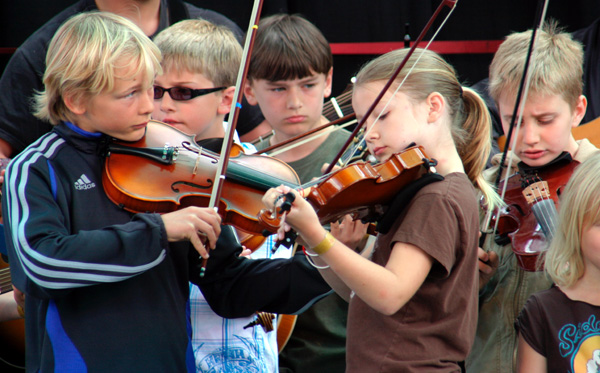 |
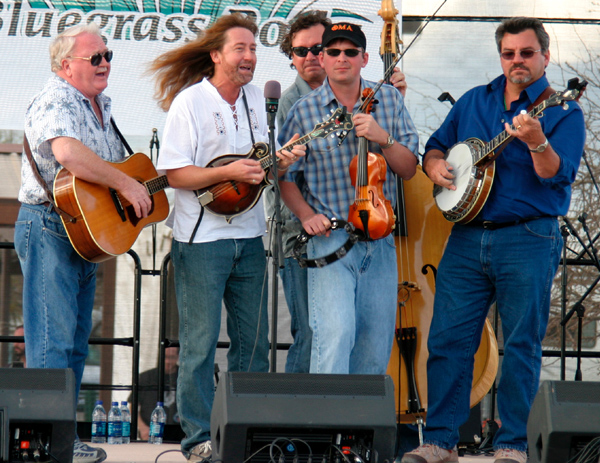
| Nothin Fancy | Kids on Stage |
|
Chapter 19 Chapter 17 Chapter 18 Chapter 20 This year was the first, last and only time I attended Summergrass, a major festival near Vista in northern San Diego County. The festival location was at the Antique Gas & Steam Engine Museum, a complex of a dozen or more buildings, with lots of antique cars and trucks, as well as engines large and small. There's also plenty of space for RV parking, and I paid the extra fee to have electricity, something that proved well worth while with the warm weather there. Music the first day started at 3 p.m., with Chris Stuart and Backcountry. This is a San Diego area band that I had seen a number of times in Parkfield, and one of the main attractions that convinced me to attend. Although their regular fiddler, Chris Ward, was absent, he was ably replaced by Megan Lynch, originally from California but now based in Nashville, where she plays with Pam Tillis and others. All the groups the first day were ones I'd seen, and most were ones I was eager to see again, especially Michael Cleveland and Flamekeeper. Chosen fiddle player of the year seven times, Michael is perhaps the hottest fiddler in bluegrass today, and always puts on a great show. I also enjoyed another performance by Jonathan Reischman and the Jaybirds, who live in Canada and Northern California, and who I've now seen three times. Several times in between sets there was a band of teenage musicians playing as "the demo band," to show off several instruments that were being raffled off. Although they did only one song each time, this group could perform a full set on stage and would not be out of place. (This group eventually became Next Generation, and performed at various festivals, including Parkfield.) The groups that were new to me, Bluegrass Brethren, Lonesome Otis, and the Tail Draggers, all played today. All were southern California bands, all competent but fairly average. Well above average were Special Consensus, Michael Cleveland & Flamekeeper, and Chris Stuart and Backcountry, all of them groups that would make me think about attending any festival where they were playing. A pleasant surprise was the continued progress of the kids in the Anderson Family. It had been close to four years since I first saw them, and they were not really ready for public performance back then. By this time they were developing into above average singers and pickers, and I looked forward to their next performance at the Hobbs Grove festival. The location was very nice - it's about ten miles from the ocean, and we had a good breeze most of the time. I sat in the sun most of the morning, and was not uncomfortable, although it was nice to move into the shade part of the time. The place is a lot like a fairgrounds, with various buildings containing exhibits, although the exhibits here are permanent, and the place is open all year. It was a long drive, but it was an excellent festival, and I was glad I finally decided to check it out. There were two more festivals for the year, the next one Brown Barn September 10 – 12. The previous year I noticed that the barn is actually red, and one of this year's MCs explained the color discrepancy - it seems that promoter Jake Quesenberry was color blind and really thought the barn was brown. By the time someone corrected him, flyers had been printed, and everyone decided to leave well enough alone. The "official" start of the festival was not till 9 a.m. Saturday, but Friday night featured an open mike event, at which any group of musicians could sign up to do a 20-minute set. Although the talent at last year's open mike was notably at the amateur level, there was a bit more planning this year, and any of the Friday night groups this year could have performed as part of the festival. Most impressive was Luke Abbott, a young man who sang solo, accompanying himself on banjo, guitar, or fiddle. In fact, he performs professionally with a family band as well as solo, and teaches music throughout the west. For one song he was joined by the amazing AJ Lee who was here last year, and who will be mentioned later in this report. At the age of 12, she was named female vocalist of the year by the Northern California Bluegrass Association. The entire Friday show, from 7 to 9, was good, and instead of heading back to the motor home early like I did last year, I stayed for the whole two hours. The previous year there were only about three groups at this event I'd ever heard of, but at the end of the festival I said I would attend again if it were the exact same lineup. This year there were 15 different groups, six of which I was familiar with, and again I make the same statement. One of the big crowd pleasers was OMGG (Obviously Minor Guys and a Girl), which consists of the aforementioned AJ Lee, 16 year old Nate Schwartz, his 11 year old brother Max, and 14 year old Marty Varner. I had seen the boys as part of the Kids on Stage presentation at the Plymouth Festival, and AJ at Paso Robles, but at Brown Barn I was blown away by their performances. They have all become even better this year, and should be entertaining bluegrass fans for decades to come. Nate and Max also appeared with Oak Grove, which included their parents and six year old sister, and again it was another of those pleasant surprises. The other outstanding group that was new to me, was Windy Hill, which includes three young men who attended high school together (not more than a half dozen years ago, I'd guess), plus Yoseff Tucker and Ella Naiman of the Dalton Mountain Gang, the number one bluegrass band in Fresno. Also back for another year was Angelica Grim and Friends. Angelica was one of the "kids on bluegrass" from an early age, and now performs professionally. She performed with various local artists, including Luke Abbott, Molly Tuttle, and AJ. There was also another Fresno band I like very much, the old-time music ensemble Red Rag Andy Band. Barry Schultz, the spokesman and main singer, usually gives a little history of each song, and more often than not it starts of with "this song dates from the 19th century..." Despite their age, some of these songs are familiar, having become part of the bluegrass repertory. I must give another shout-out to Snap Jackson and the Knock on Wood Players, who I first saw the previous year and who also played this year at Parkfield. Their musical style defies description, other than to say it is rousing and always gets an enthusiastic reception. Chatting with Snap, I told him I had a hard time explaining his music to people, and he said they have the same problem..."just come and see us and find out!" On stage, Snap told how his best friend in 8th grade belonged to a family who were all Grateful Dead fans. Snap also enjoyed the Dead, and the father of the family suggested he might want to check out one of Jerry Garcia's side projects, the bluegrass group Old and in the Way. As Snap explained it, "When I heard that, I said 'That's what I want to do'...and that's how a Mexican boy from Stockton became a bluegrass musician." Another excellent band, that I had seen several times over the years, was Sidesaddle and Company, based in the general area of Santa Cruz-Hollister. They had been around for 20 years or more, and did a great job this year. One "only at a bluegrass festival" moment came during the performance of the Pleasant Valley Boys, who take a traditional approach. They've recently released a recording - not a CD, not a vinyl album, but a 78 RPM record. Fittingly enough, the best set of the festival was the Saturday night closer, the Dalton Mountain Gang. They were received with loud enthusiasm, and it seemed to inspire them to play the hottest set I've ever seen them do. Happily, DMG, Red Rag Andy and Snap Jackson will all be at the Hobbs Grove festival, 20 miles from my house, at the end the month. After eight days back at home, I set out September 24 for Hobbs Grove. My friend and sometimes traveling companion, Janell Sidney, had taken the day off from work so she could attend the entire festival for the first time. I’ll keep this brief since I want to finish up the year with this chapter. I had seen many of the groups at Hobbs at other festivals and they need no further comment. But I think Belle Monroe and her Brewglass Boys deserve a shout-out, not only for their music, but for the triple-pun group name. Another first-time group was The Tuttles and AJ Lee, a family band that eventually sent members into several other groups. Jack Tuttle, long-time Bay Area musician and teacher guided AJ, his son Sully (now with AJ’s group) and daughter Molly, who should need no introduction. Bye for now! |
|
|
|
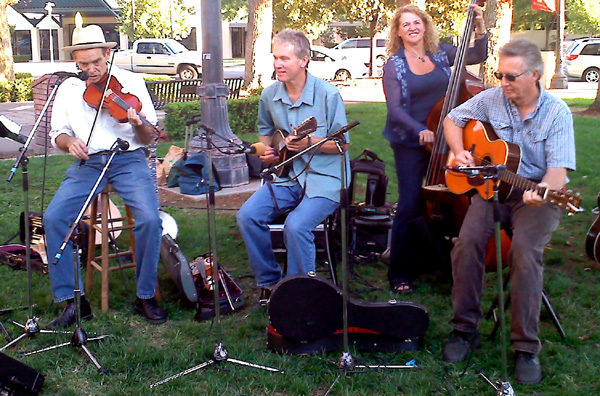
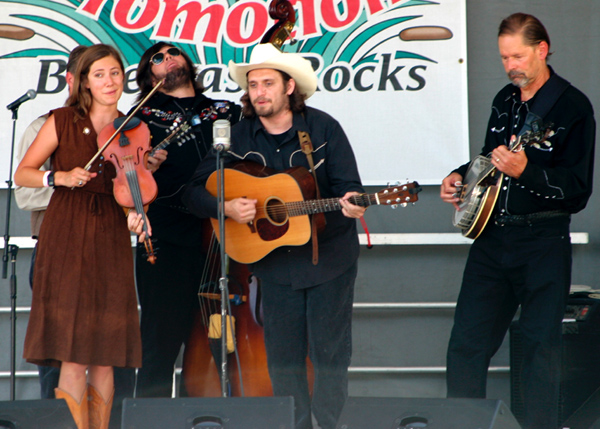
| Red Rag Andy Band | Dalton Mountain Gang |
|
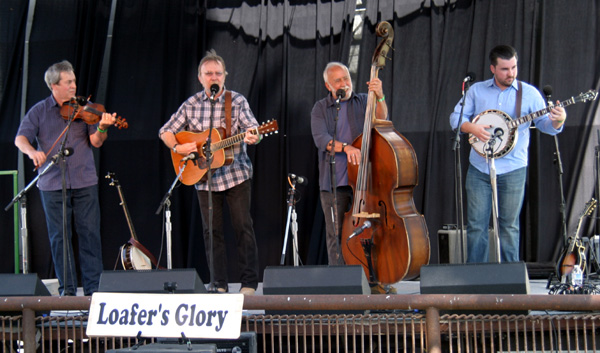
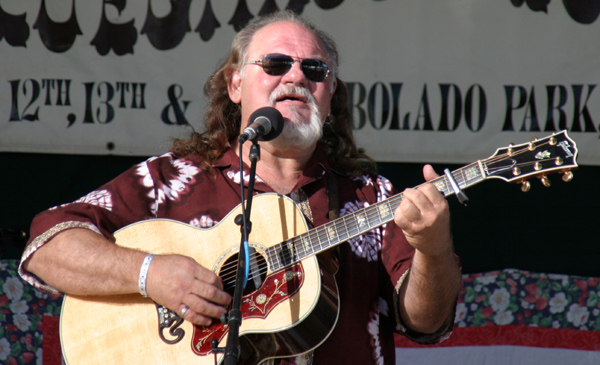
Chapter 20 Chapter 17 Chapter 18 Chapter 19 May, 2011 marked the 13th year of the Parkfield Bluegrass Festival, and I had been there for ten of them. This year I was joined for the entire festival by my friend Janell Sidney. Before last fall she had attended a couple of festivals for just a day or two. She took off a day of work to attend the entire Hobbs Grove Festival in September, and realized how much better it was than working, so she requested two days vacation to attend all four days at Parkfield The festival started on Thursday and included the Get Down Boys, a rather unusual group, in that several of the members had received formal training at the prestigious Julliard School of Music in New York City (although such backgrounds are not as rare in bluegrass as you might think). They appeared to all be in their 20s, and brought a very contemporary touch to the proceedings.. The evening's program brought the "pleasant surprise" group of the festival, Loafer's Glory. This was a new combination of veteran players, three of whom I'd seen a number of times. Bill Bryson, an excellent singer, song-writer, and bass player, had played in a number of bands, as well as doing session work, and I've seen him with at least five different groups. Herb Pedersen sang and played guitar with this group, but he's better known for his banjo work, and as a member of the country rock Desert Rose Band with former Byrd Chris Hillman. Herb has done instrumental and vocal harmony work on dozens of albums for big name artists including Linda Ronstadt and John Denver. Patrick Sauber played banjo and sang with several other groups that I'd seen. Rounding out the group was Pat's father, Tom on mandolin and vocals. He is also an excellent banjo player in the old-time style, and did several numbers with his son. Happily, this group was scheduled to perform a total of four times. Glorious indeed, but definitely not loafers. The rest of the festival was the usual combination of familiar and not-so-familiar bands, excellent and average bands, plus plenty of relaxing, eating and talking. The biggest name band present was Lost and Found, which started in Virginia in 1973. The anchor man in this group is Allen Mills, lead vocalist and bass player, who has been joined by a number of top level players over the band's nearly 40 years. I saw them several times, and they were always excellent. The other "headline" group was Laurie Lewis and the Right Hands, who needs no introduction to Fresno folklore fans. She appeared twice in 2025 and 2026 at Fresno’s Wolk Garden, not with a band but accompanied by guitarist Nina Gerber, a long-time collaborator. Laurie has been a fixture in the Bay Area bluegrass scene since the 1970s, and appeared with her full five-person bluegrass group, including Patrick Sauber and singer-mandolin player Tom Rozum, who had been part of Lewis' musical efforts for many years. Several years earlier I realized I needed to take more photos around town, because there were changes every year, in what most people would see as a small, sleepy town. Since the previous year the town residents had put a new roof on the community center. There was a new building on one lot (apparently part of a ranching/farming operation). A row of mail boxes along the main street now boasted a cover. And near the lodge there was a small swimming pool. An old building a block off the main street burned down earlier in 2011. In the 1890's it was the original Parkfield Hotel. Some of these photos are displayed on my Parkfield photo page. Things that have stayed the same include an elderly basset hound that wandered into the audience area (ignoring the "no pets" sign), jumped up on the bench that surrounds a fountain, and got a drink. Normally I stay till the end of the festival and go home the next day. Janell had to go back to work Monday, so we got a lot of stuff ready to go during the Sunday lunch break, skipped the last two groups, and got started home around 4 p.m. I must give a salute to Janell's twin daughters, Nichole and Jessica, who welcomed our return with home-made chocolate chip cookies. June and July went by and it was time for my first visit to the Good Old Fashioned Festival at the San Benito County Fairgrounds near Hollister. The event was well-established – this was its 18th year. There were some negatives – drying straw and manure near the camp area from the fair a short time earlier, which attracted about a million flies. Although I had quite a few in my motor home, they were not interested in the green grassy area where the show took place, so we were not bothered during the music. An odd policy of this festival was that each group performed only once. For some, once was enough, but there were some I wished were on two or three times, which is the usual approach. Familiar bands included Snap Jackson, Bean Creek, OMGG, and Sidesaddle & Co. However, I can give a big shout-out to Susie Glaze and the Hilonesome Band, a group from Southern California that I had never heard of, and that proved to be the amazing discovery of this festival. Susie has a gentle but powerful voice, and a talented band, and I hope I can see them again. One set was not enough for this band. Check her out on You Tube. This was the most electrified bluegrass festival I've ever attended. Two groups used nearly all electrical instruments, as well as drums (and keyboards in one case), and both were too loud. I didn't care for the first one, the JEDD Brothers, but Houston Jones was quite interesting, with lyrics that made you sit up and take notice. It wasn't bluegrass, but it was OK. Listen to the songs available on You Tube Historical note: The festival program featured a picture of Bill Monroe in honor of the 100th anniversary of his birth. I’d like to address a non-musical matter common to most festivals – audience seating. Except for the rare indoor festival, no one arrives expecting to find a seat waiting for them. Instead everyone brings their own chair. Placing the chairs is a big thing at some festivals. At some they ask you not to set up your chair until the sound crew has finished its set-up, which often includes running a cable through the audience seating area. I like to sit in about the 5th to 7th row, so I head out with my chair as soon as I am allowed. There are no chair thieves at bluegrass festivals; everyone just leaves their chair in place the whole weekend. If rain is possible, people fold the chairs and lay them flat on the ground. At the CBA’s Father’s Day Festival, chair placement is a VERY big deal, with lots of rules. People often stand in line waiting to take their chairs in. There is even a special time for older people to bring their chairs, a subject that has caused resentment from younger fans. A rule that is standard at most events – if a chair is unoccupied, it’s OK to sit in it. But you must yield it immediately if the owner arrives. |
|
|
|
| Loafer's Glory | Houston Jones |