|
Dick's Bluegrass
Odyssey Volume 1 |
|
| Related Links | |
| Chapters 1 - 4 Chapters 5 - 8 Chapters 9 - 12 Chapters 13 - 16 | |
|
Parts of this series originally appeared in the Fresno Folklore Society Flyer. Having attended nearly 60 bluegrass festivals from 1997 to 2019, I offered to write about these adventures for the Folklore newsletter, and received a positive response. After publishing the first five, it was decided to discontinue publishing them. By this time I had finished the entire series in rough draft form, and was working on getting each subsequent chapter ready for submission. Since they will not appear in the newsletter, I will be posting the rest of the chapters here (as well as the first five), where I can include more links to artists and related subjects. It looks like I will be able to put three or four chapters in each web page. It should be noted that information about most of these festivals has been included in my endless series of travel reports. But those pages were written for a general audience, with more emphasis on the journey and other activities and less on the music and musicians. This series is aimed specifically at fans of folk music, which we prove below includes bluegrass. --Dick Estel, September 2026 |
|
|
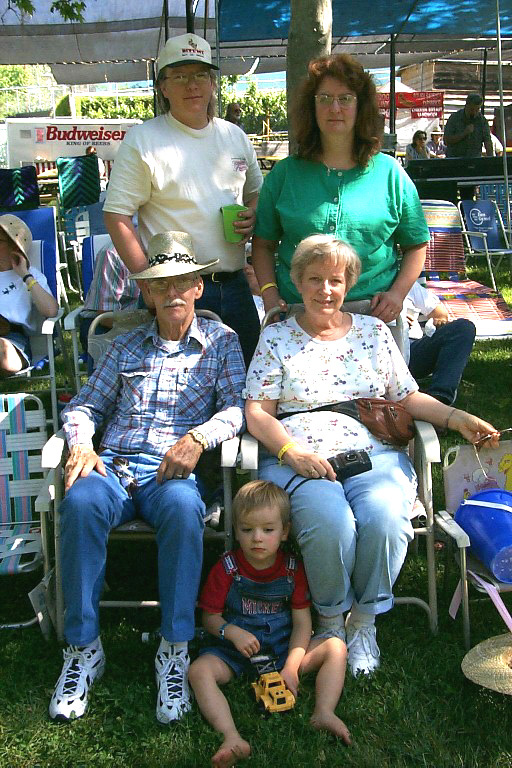
My Bluegrass Odyssey Chapter 1 Chapter 2 Chapter 3 Chapter 4 By Dick Estel For some time I have been slightly envious of Sue Wirt. We have similar travel interests, and it seemed like every time I would mention some place I’d been or was planning to go, Sue would reply, “Oh, I’ve been there.” But one place she has not been is to 59 bluegrass festivals. So I decided to write a series of articles on this activity which was one of my main interests for about 20 years as the 21st Century began. First I wondered, would FFS readers consider bluegrass to be folk music? I have two answers. Louis Armstrong said, (approximately) “It’s all folk music. I ain’t never heard no animals making music.” (I know, this could be debated.) But more to the point, think back to the late 1950s and 1960s. Bluegrass music was experiencing a decline in popularity. A new, smoothed out type of folk music was a big thing – The Kingston Trio, Brothers Four, Limeliters, The Journeymen, Peter, Paul & Mary, and many more. One thing most of these groups had in common was a banjo, and the newly-minted folk fans of the day seized on this as an essential part of folk music. Of course, none of these groups played bluegrass banjo, but these fans didn’t know Scruggs from Peabody. Record companies were quick to recognize this interest, and a number of bluegrass albums were issued that had the words “bluegrass folk music” somewhere on the album, often with a picture of a banjo featured prominently The Internet, an “infallible” source, says: “While some purists might distinguish between ‘folk’ (traditional, community-based) and ‘bluegrass’ (professional, performance-based), it is generally recognized as a modern evolution within the American folk tradition.” So yes, bluegrass IS folk music, and I will now enlighten and/or burden you with a few thousand words about My Bluegrass Odyssey. Although I liked the new modern folk groups, I was already a bluegrass fan, but a very casual one. Back in the good old days, bluegrass was not considered separate from country music – you’d hear it on The Grand Ole Opry and similar programs, and on country music stations. TV shows such as the Porter Wagoner Show and others would include bluegrass musicians along with the more mainstream country stars of the day. I always enjoyed bluegrass, and at the time thought of it as just a part of country music. One thing that really piqued my interest was a TV broadcast that I happened to see some time in the 1960s. It featured Lester Flatt & Earl Scruggs playing “Salty Dog Blues,” (AKA "Old Salty Dog Blues") and I was amazed and impressed at the performance. When each player took his solo, he stepped up to the mike and played his part with precision, looking as if it was the easiest thing in the world. This song has been my favorite bluegrass song ever since. Even so, my fandom remained casual and bluegrass competed with other types of music for my attention. In the 1990s I started buying some bluegrass albums and in 1997, I discovered that there was a bluegrass festival at the fairgrounds in my home town of Mariposa CA. I went there often to visit my parents, so I decided to check out the festival, and took in the Saturday afternoon and evening shows, joined by my younger daughter and her husband, Jennifer & Rod, hardcore rock fans. One of the groups was the Laurel Canyon Ramblers, which meant nothing to me at first. Then they introduced the banjo player, Herb Pedersen. My friend Gary and I had watched a number of country and bluegrass music shows on TV in the 1980s and 90s, and Herb seemed to pop up as a side man with many groups. His name also appears on many acoustic and pop albums. I was duly impressed and could not wait to tell Gary that I had seen and heard Herb live and in person. The next year (May 1998) I went to the 7th annual Mariposa festival on Saturday, joined this time by my older daughter and her family, Teri, Tim and year-old grandson Mikie. In 1999 I took Friday off from work and attended my first full weekend festival. I didn’t take my travel trailer, but instead spent the night at my parents' house after the music ended Friday and Saturday nights. Tim & Teri decided that the next year, they would go with me for the weekend, and in 2000, for the first time, I took my trailer. Both grandsons, Mikie and Johnny, came along, as well as Johnny's friend and hockey teammate Moses, and Tim’s parents, Marge & Rocky. This time I took off work so we could go on Thursday. Everyone enjoyed the festival in their own way...the adults for the music and just getting away from the day to day routine...Mikie just because he enjoyed life nearly all the time...Johnny and Moses hanging out together and doing whatever they could find to do. They went to town most of Saturday; and went out to dinner with Dad and Mother. At these and other festivals in the future I was privileged to see and hear (and often chat with) some of the biggest names in bluegrass, as well as many lesser or unknown but incredible musicians. I have most of the programs from festivals I attended, and even if the names meant nothing to me then, looking back I’m delighted to realize I saw such local heroes as Bearrr Murray and Bruce Honeyman (in the group Drought Tolerant). Better known were Frank Wakefield, the Fox Family from upstate New York, and Continental Divide with David Parmley, formerly with the Bluegrass Cardinals. I also saw the Witcher Brothers, Laurie Lewis and her Bluegrass Pals, Lynn Morris Band, Sidesaddle & Company and Lost Highway. In 2000 we were entertained and amazed by Kathy Kalick, Mountain Heart, and Ron Spears. A special shout-out to the Fox Family, who I saw twice in Mariposa and twice in Parkfield. Lead singer Kim Fox is an amazing songwriter, and the family harmony with Barb and Joel is the kind that raises the hair on the back of your neck. They hail from Old Forge in the Adirondacks, and it was fun for me to tell them that I had been to their town in the 1970s. After attending our fourth Mariposa festival, we all immediately agreed that we would return next year (2001), but it was not to be. The Mariposa Arts Council decided not to hold the festivals any longer, so I started looking into a festival I had heard of that would be held in Parkfield, in the Monterey County hills west of Fresno. Teri, Mikie and I went to it, and I missed only one between that time and 2019. More about that in Chapter 2. |
|
 |
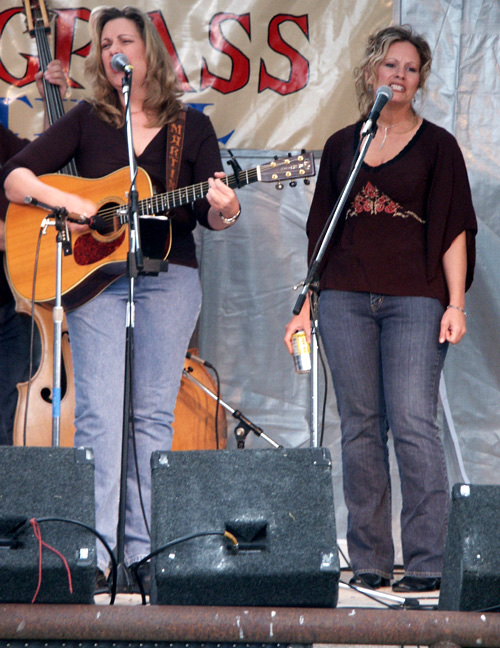 |
| Tim & Teri Liddle, Rocky & Marge Rockwell, Mikie Liddle | Kim and Barb Fox |
|
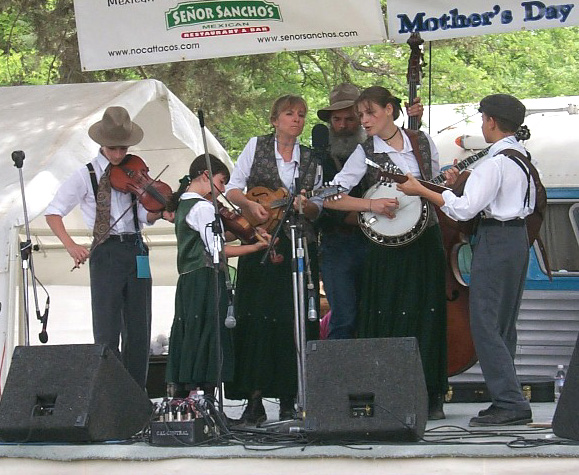
Chapter 2 Chapter 1 Chapter 3 Chapter 4 As noted above, my first experience attending a bluegrass festival was in Mariposa in 1997, the 6th such event. They had managed to hold five without my knowledge, but after attending four years in a row, I was hooked. Our plans to attend a fifth year were thwarted when the series ended. I heard several reasons for this. The fairgrounds raised their rate to an unaffordable level. Co-sponsor California Bluegrass Association (CBA) backed out as sponsor. Martians were going to levitate every banjo that appeared at the festival. OK, I made up that last one, but I never heard from anyone who really knew for sure, and the real reason was probably equally ridiculous. However, there were other options. Even before that final event, I had read of a festival getting started in Parkfield. If you drive out of Fresno toward the coast on State Route 41, where Route 46 comes in from Bakersfield there is a road going straight north. Drive 15 miles on this and you will reach a small town, whose population sign fluctuated, but always in the low double digits. The last time I noticed, it said “Population 18.” I had actually been to Parkfield once before, with no idea that I would be returning nearly 20 times over the next few years. While visiting a friend in Avenal, he took me for a ride, and we ending up enjoying breakfast at the Parkfield Café. The town is just over the hills from Avenal, but it’s 45 miles by road – down Highway 33 to 41, west to Cholame Road, north to Parkfield-Coalinga Road, then less than a mile across Little Cholame Creek and the San Andreas Fault into town. Yes, Parkfield has one more claim to fame – home to “the world’s most earth-shaking bluegrass festival.” The US Geographical Survey has a building there containing equipment to measure earth movement, and scientists rush there (slowly on that narrow, rough road) when there’s a shake in the area. The slogan of the earliest festivals was “Be here when it happens.” Fortunately I missed out, but there was one pretty good quake in 2004, not during the festival. SO – daughter Teri, grandson Mikie and I went to Parkfield for the first time on Mother’s Day weekend 2001. I drove my pickup, towing a 28-foot travel trailer. Virtually every festival offers camping, and you can buy tickets for the entire show and camping, or just for one or two days, show only or show and camping. We had signed up for the full weekend. After we checked in, we were directed down unpaved Oak Street toward the rodeo grounds and the “boondocks” camping area. Here we joined other trailers, motor homes and tents under a grove of valley oak trees. Very soon we experienced one of the “bonuses” that are common at these events – we made the acquaintance of our next door neighbor, Walt from Santa Barbara. We would enjoy seeing and talking with him for years at a number of later festivals, both at Parkfield and elsewhere. With a 3 ½ year old child with us, we soon attracted the attention of a couple who became sort of “bluegrass grandparents” to Mikie. Rad and Tele lived in Tulare and knew many of the people involved in bluegrass in Fresno and elsewhere in the valley, and we would enjoy their company most years at Parkfield, and a couple of times at another festival closer to home. The friendly atmosphere at these events and the small crowds at Parkfield made it a perfect place to allow a young boy to be a free range kid, and Mikie’s favorite activity at the festival was catching lizards, which he brought to the audience area and proudly displayed. We were familiar with only one or two of the groups on the bill, although some became favorites and we would come to see some of them a number of times. One of the first groups was the String Bandits from Fresno, which was my first encounter with Mike McDonald, who eventually seemed to play with half the groups in the central valley area. Chris Jones had recently formed the Night Drivers, and was one of our favorites. Some time later I watched a tape I had made a few years earlier of a show called Fire on the Mountain, featuring Special Consensus, and there, singing lead, was Chris. We also enjoyed the Witcher Brothers, who we had seen in Mariposa, and the Grateful Dudes, featuring bass player and singer Bill Bryson, another musician who popped up in many different groups, mostly from southern California. Over the years at each festival I would experience what I considered “a revelation” – a group that was unknown to me but that stood out above the rest. At this festival it was the Cherryholmes Family, a band that started playing in the parking lots at festivals and became good enough to move up to the main stage. In addition to the parents, there were two sons, a fiddler and guitarist, and two daughters. The youngest was about 9 and played fiddle with a skill well beyond what you would expect for her age. Head and shoulders above them all was 18-year old Cia, who sang and played banjo with professional skill. I would see this group a number of times, and watch as they became a national touring band, mentored at different points by Jimmy Martin, Rhonda Vincent and Ricky Skaggs. Most of the time I have tried to stay at festivals until the last note has died out on Sunday afternoon. Since I was still nearly a year away from retirement, Teri and I both had to return to work Monday morning, so as far as I can remember, we got an early start, skipping the final act, one that had appeared twice already. While my family was rarely able to join me, it always made the event more special when they could, and Teri had become and remains a bluegrass fan to this day. |
|
 |
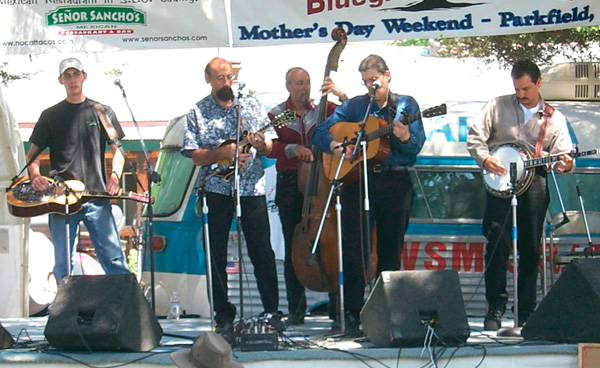 |
| Cherryholmes Family | Witcher Brothers Band |
|
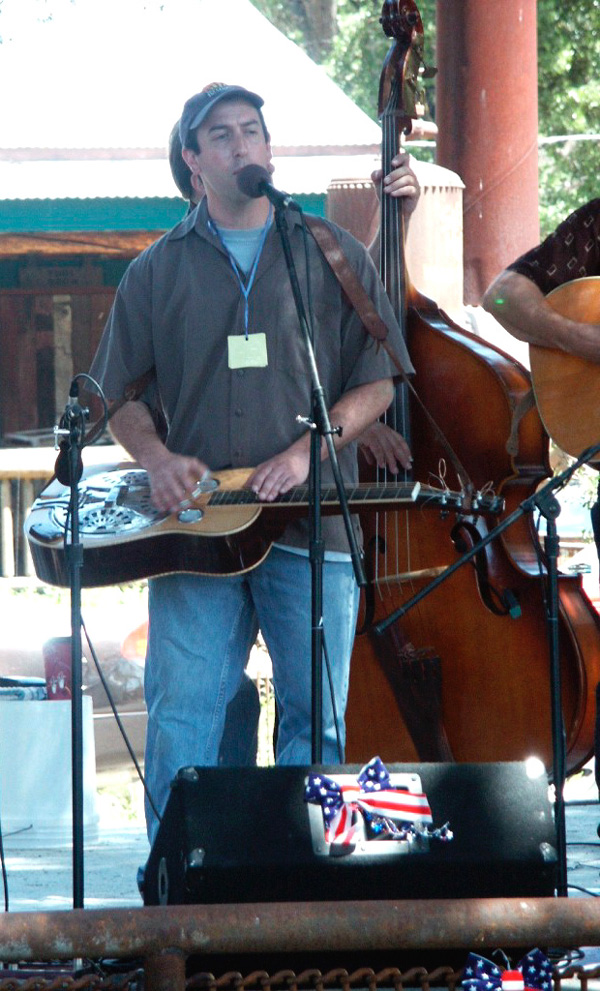
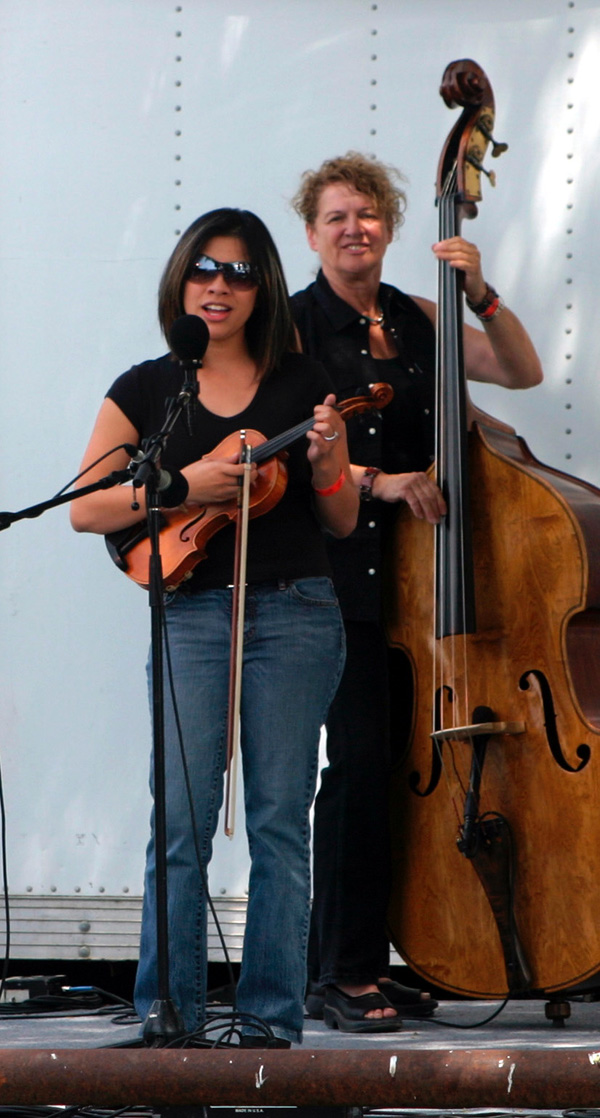
Chapter 3 Chapter 1 Chapter 2 Chapter 4 I was absolutely convinced that I attended every Parkfield festival from 2001 through 2019 except 2007. However, I can find no record of the 2002 event, not in my journal, not in my on-line travel blog, and no photos. I don’t have a program for that year. There’s no doubt that a festival was held that year. An on-line search produced an article from the Monterey County Newsletter, dated May 9, 2002, with the band line-up and quotes from the promoter. Most of the band names were familiar to me, but this does not prove anything – many of the same acts returned year after year. The first few Parkfield events were promoted by Pat and Rosie Conway, who I believe hailed from Porterville. They dubbed those early events the Camp Rude Festival, and the article mentions the Camp Rude motto: Less rules, more fun. Pat went on to say, “The main festivals you go to are over-managed, micromanaged to the point it’s no fun.” Unspoken was the rumor, confirmed by some fairly reliable sources, that the Conway’s were kicked out of the Father’s Day Festival in Grass Valley, sponsored by the California Bluegrass Association (CBA). I have never attended that event, but information about it in the CBA newsletter, Bluegrass Breakdown, makes it clear that there are certainly plenty of rules. With or without Parkfield, I was not deprived of bluegrass music in 2002. The previous year I had made the acquaintance of Ivan Rosenberg, a highly skilled resonator guitar (Dobro) player whose band was based out of Montana. I asked him if there were any festivals in that state in July. I was planning a trip to Ohio, where I would spend nearly a month at an RV park in Fulton County, where my parents were from, and where they were spending the summer. On the way back I would be taking US Highway 2 along the northern edge of the US. Ivan told me that there was bluegrass every Tuesday night at the Top Hat Bar in Missoula. Heading home from Ohio in 2002, I was able to make that fit my schedule, going south from US 2 on US 93 and setting up for two nights in a nice RV park about ten miles from town. The evening was interesting and enjoyable. The Top Hat seemed like a typical Montana dive (don’t think moose heads and cowboy hats, but mostly young people in shorts and T-shirts, lots of beer signs on the wall, smoke, talking, and four pool tables constantly busy). The jam session prior to the “official” band was actually more enjoyable than the scheduled group, which had a LOUD sound system, plus lots of patrons talking over the music. Ivan said he had told a lot of people about Tuesdays at the Top Hat, but I was the first to actually show up. He played with a changing group of about ten people. As always at jam sessions, there were people there who had never been there before, including a young couple from Portland who did a great version of the Hazel Dickens classic, My Better Years. And as usual, throughout the jam everyone jumped in and played like they had rehearsed for hours. I returned to my trailer, ready to move on the next day and well satisfied with my side trip to Missoula. On the way home I visited Glacier and Crater Lake National Parks, and did some other stuff, none of it related to bluegrass. Back home after my two-month trip, there was an event much closer to home – the Hobbs Grove Festival in the country near Sanger, a small town a few miles southeast of Fresno. (In some years it was known as the Kings River festival.) Hobbs Grove was best known as a Halloween venue, but it had also become the location for a small festival featuring mostly local bands. It drifted back and forth between the two names, but for convenience I’ll refer to it as Hobbs Grove for all nine years I attended. My first time there was in 2001, but the only information I have to document that is a sentence from my journal about the 2002 event, a reference to “the outstanding singer from last year.” If our ancestors and predecessors were as bad as I sometimes am at keeping records, it’s no wonder there are disagreements over the accuracy of historical accounts. On Friday, September 13, 2002, younger grandson Mikie and I went out wth the trailer, and had pizza for dinner. The area where people could park was about two or three acres of grass, so Mikie could run around to his heart’s content, hunting for bugs, often a favorite activity for five-year old boys. The next day the festival started at 10 a.m. Mikie continued his bug hunt in the area away from the spectators. Through the day, he started playing with various kids. At the peak there was a group of at least ten, from age 3 to about 12. He did not even want to stop for lunch, and cried when we left for the trailer at 9 p.m., having had only 11 hours of playtime. Daughter Teri, her husband Tim, and his parents, Marge and Rocky joined us later that day, but only Teri stayed overnight. The festival was advertised as Bluegrass and Country, with “country” in small letters, but it should probably have been reversed. In my view, the three essential bluegrass instruments are banjo, mandolin and fiddle, and electric guitar is rarely acceptable. Groups can sound fine with only two of the essentials, but that’s probably a minimum. Nearly half the groups had electric guitar, and played music that was more country than bluegrass. That said, at least it was older honky tonk style. Not one group had all three “essential instruments,” and few had even two. Most of the groups that were all acoustic played music that leaned toward Irish or old-time rather than bluegrass. There were only two groups that I would consider true bluegrass. One of the best groups was A Full Deck, which had a hot fiddler and an electric guitar that fit in with what they were doing. In another group, the outstanding singer from the previous year, Dee Richter, sang even more songs this year, and when not singing, played old-time fiddle tunes. But their group had an electric guitar that did not fit well. The other group I enjoyed a lot was Kenny Hall and the Long Haul String Band. Kenny was well-known to members of FFS, had been active in this area for over 30 years, and was known throughout the US among old-time musicians and fans. Their music was definitely Irish and old-time, patterned on Gid Tanner and the Skillet Lickers. Kenny played mandolin (not the bluegrass style instrument) and fiddle, but I liked it better when he played mandolin. I'll cover the rest of 2002 in the next installment below. |
|
|
|
| Ivan Rosenberg AKA Uncle Slosh | Dee Richter (now Johnson) |
|
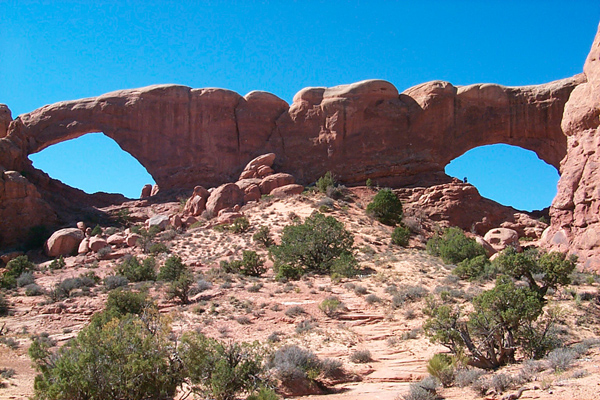
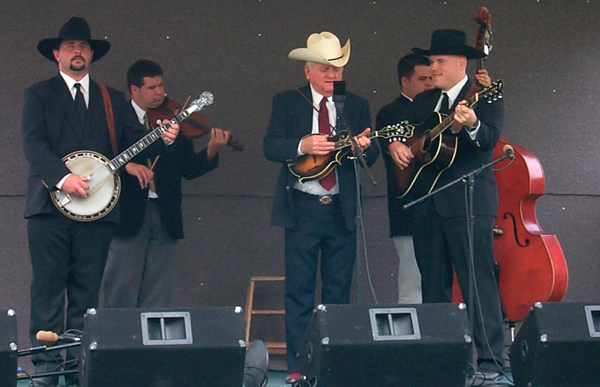
Chapter 4 Chapter 1 Chapter 2 Chapter 3 The year 2002 ended with an excellent festival and a visit to a place that had been on my bucket list for some time. By this time I had subscribed to one or two bluegrass association newsletters, including Southwest Bluegrass Association (SWBA). In this way I learned about festivals all over the west and in 2002 this included the 13th annual Logandale Bluegrass Festival. Logandale is about 60 miles from Las Vegas, just off I-15, and the site of the Clark County fairgrounds. I decided to make it a two-week vacation, attending the festival, then going on to Arches National Park in Utah. After an overnight stop in Barstow, I arrived at Logandale about 2 p.m. on Wednesday, got in a line of RV’s just entering the grounds, and got a spot with water and electricity. This is a luxury not found at every festival, usually available in limited numbers. People arriving after this day had to dry camp. I could do that, but it would have meant running a generator for a couple of hours each day. It was at this festival that I became acquainted with a group of people who were from the Salt Lake area. They became “bluegrass friends” at this and the following year’s festival, and I stayed in touch with Danny, a country musician who was attending his first bluegrass event. One of the big attractions of festivals is “jamming,” or jam sessions in which any number of folks get together to sing and play. These are mostly amateurs, many of them quite skilled, but it’s not unusual for some of the paid performers to join in. Jams often go on till the wee hours, and I have observed that some attendees never go to the main stage, but just hang out in their camps playing music the entire festival. My main goal was always to see all the stage performances, but I often observed a jam for a while during meal breaks or at the end of the day. Although I own a guitar, I did not participate except for a short time at the Logandale festival. I describe my singing and musicianship this way: If there’s a jam in your camp and you want everyone to leave so you can go to bed, that’s when you ask me to sing and play. One reason I tried to arrive on Wednesday for festivals that started on Friday was to explore the area on Thursday. A few miles down Nevada Highway 169 is the Valley of Fire State Park. I did a short hike there and enjoyed seeing the odd shapes and various shades of the sandstone rock that gives the place its name. Once the music got under way, three groups stood out for me at this event. The Liberty Bluegrass Boys were a hard-driving traditional band, led by Roy Bennett from Liberty TX. He was joined by Digger Davis, the 1999 State of Texas Banjo Champion, and two “pickup musicians” from California, Joe Ash on bass and Mike Tatar Jr. on fiddle, who I would see with various other line-ups. The Lampkins Family consisted of mom and dad, daughter Jamie, and her best friend Heather. Jamie was an absolute maniac on the banjo, playing at supersonic speed. The two girls were around 19 or 20 at this time, and I’ve been unable to find out what became of this band. Probably adulthood ended their existence, as it has so many others. I first saw Ron Spears & Within Tradition at one of the Mariposa festivals. I would see him in various settings over the years, and eventually he dissolved the band and for a while was a limousine driver in Nashville. His band included another artist who would pop up in various settings, the excellent guitarist Charlie Edsall, I enjoyed the entire festival, the weather, the surroundings, and the good company. Now it was time to head for Utah and Arches National Park. My parents had been there a number of years earlier and spoke highly of the place, especially Delicate Arch. So I drove out to I-15 and headed to the Nevada border. This highway crosses a corner of northwestern Arizona, following the Virgin River Canyon through a mountain range, before entering Utah and the border town of St. George. I continued north to Cedar City, then took Utah Highway 14 east over an 11,000 foot pass to US 89, where I turned north to I-70. After staying overnight at Richfield, UT, I enjoyed my first trip across that state through the magical landscape of the Colorado Plateau. US 191 took me south to Moab, the jumping off point for Arches and Canyonlands National Parks. I stayed in an RV park about ten miles south of the entrance to Arches. The national park exceeded all expectations. Words and even pictures can’t adequately show the dramatic sandstone walls, weird shapes and the arches. Let it be sufficient to say that if the park had not a single arch, it would still be worth seeing. I spent five days, hiking and driving to most of the major points of interest in Arches and the Island in the Sky district of Canyonlands. I ended up adding an extra day to my stay since I found I could not get everywhere I wanted in just four days. And I have been compelled to return at least five more times. Arches has become my second favorite national park after Yosemite. Now if they’d just schedule a bluegrass festival at the Windows Section of Arches National Park. |
|
|
|
| Windows Arches | Liberty Bluegrass Boys |